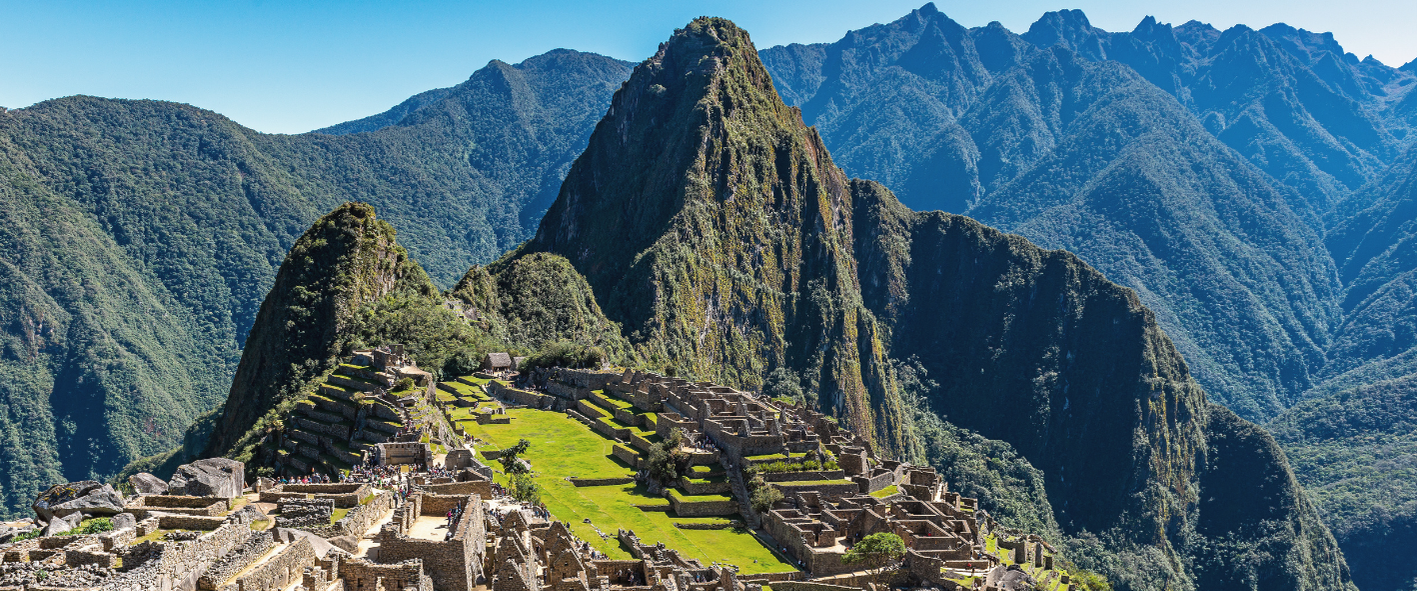
Machu Picchu on the first entry slot of the day, descending from the Sun Gate with an archaeologist who has worked the site for two decades. The Vistadome glass-roof train through the Urubamba gorge. A night with a Quechua family on a Lake Titicaca island with no electricity.
Design your Peru journey →Peru contains three distinct worlds stacked vertically: the coastal desert where Lima sits, the Andean highlands where Inca civilisation built its most durable structures, and the Amazon basin that covers sixty percent of the country's territory and most of its biodiversity. Most travellers engage only with the middle world, which is understandable — Cusco, the Sacred Valley, and Machu Picchu constitute one of the most significant archaeological landscapes on Earth. But the design of a Peru journey that goes beyond the Inca trail requires choosing entry points into the other worlds: Lima's food scene, which has been recognised internationally as the most sophisticated in the Americas, and the Amazon basin, where a riverboat journey from Iquitos into the Pacaya-Samiria National Reserve reveals an ecology of staggering complexity. The Andean world rewards the traveller who arrives slowly — acclimatising in Cusco for two days before the high altitudes of the Sacred Valley, taking the train rather than the bus, and having an archaeologist rather than a guide at Machu Picchu.
The first entry slot to Machu Picchu begins at 6 a.m., and we book the Sun Gate (Inti Punku) access which allows a descent from the mountain path above the site rather than arrival through the main gate. At this hour, the citadel is emerging from cloud below you — the terracing and the Temple of the Sun visible in sequence as you descend, the way the Inca engineers intended the city to be approached. Our archaeologist has published on the hydraulic engineering of the site and uses the walk to explain what you are seeing as a working city rather than a ruin: water systems, residential quarters, astronomical alignments.
The train journey from Ollantaytambo to Aguas Calientes descends 2,000 metres through the Urubamba gorge in ninety minutes — the Andes mountains narrowing around the track, orchids appearing on the cliffs, the vegetation shifting from highland grassland to cloud forest to subtropical jungle within the same journey. We book the Vistadome carriages with panoramic glass ceilings, and time the departure for the afternoon when the light on the gorge walls is most direct. The return journey the following morning is equally worthwhile in the opposite direction, watching the altitude return.
Lake Titicaca at 3,800 metres is the highest navigable lake in the world, and the Uros people have lived on floating islands of totora reed for centuries — a technology of such elegance that the islands are self-repairing and self-propelled. We arrange a genuine homestay with a specific family on one of the islands beyond the tourist route, arriving by private boat in the late afternoon, sharing the evening meal of chuño (freeze-dried potato) and trout from the lake, and sleeping in the family's reed-walled guest room where the stars, at altitude and without any light pollution, are extraordinary. A morning with the family before the day-tourist boats arrive is among the most peaceful hours in Peru.
Lima for gastronomy, Cusco for acclimatisation, the Sacred Valley, Machu Picchu, and Lake Titicaca. Best May through October in the dry season when skies are clear and the mountain light is at its sharpest.
Two nights in Lima's Miraflores district. Evening one: dinner at Central (chef Virgilio Martínez's restaurant, multiple years in the world's top ten), where the tasting menu maps Peru's altitude bands from sea level to 4,000 metres through specific ingredients at each elevation. Evening two: Kjolle, run by Pía León, which focuses specifically on Peruvian native ingredients — 3,000 varieties of potato, 35 varieties of corn — in a cooking that has no reference point outside Peru.
Fly to Cusco (3,400m) and take two full days for acclimatisation. Day one: the San Blas neighbourhood's artisan workshops on foot; the Qorikancha (Temple of the Sun) private guided visit in the late morning when light enters the alignment windows. Day two: rest morning, afternoon at the Sacsayhuamán fortress above the city — the stone fitting precision examined up close with the archaeologist.
Transfer to the Sacred Valley and base at a small hotel near Urubamba. Day one: a morning at a quinoa farm in the valley — one of the few remaining operations growing native Andean varieties (not the commercial cultivars) with a farmer who explains the agro-ecology of the altiplano. Day two: Ollantaytambo fortress at 7 a.m. before the tourist buses, with the same archaeologist from Machu Picchu. Day three: departure on the afternoon Vistadome to Aguas Calientes.
First-entry permit on day one: Sun Gate descent with the archaeologist, two hours before the main gate opens. Full circuit of the citadel including the Intihuatana stone, the Temple of the Three Windows, and the agricultural sector. Day two: Huayna Picchu mountain permit (maximum 400 people per day) for the view from directly above the site — a different geometry entirely. Return to Cusco on the evening Vistadome.
Fly to Juliaca and transfer to Puno on the lake shore. Private boat to a homestay island for one night with the Uros family. Day three: Taquile Island, whose textile tradition is a UNESCO Intangible Cultural Heritage — the weavers explain the semiotic system encoded in the patterns. Return to Puno and fly to Lima for international connections.
A city built above the clouds by engineers who understood water, stone, and the movement of the sun — arriving the right way changes what you see.
Begin your journey