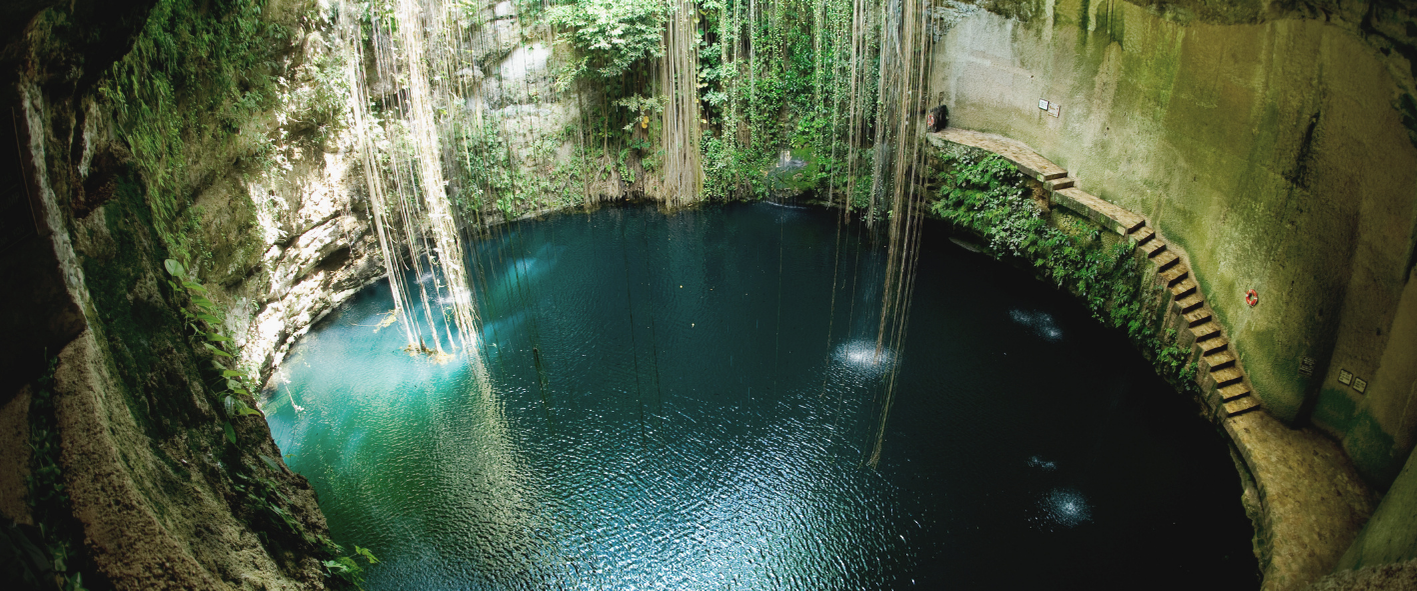
Mexico City private art collections that never open to the public. An Oaxacan mezcal distillery where the maestro explains the difference between a papalometl and a tobalá in his own language. A cenote in the Yucatán before the first tour van arrives.
Design your Mexico journey →Mexico is one of the most densely layered civilisations on Earth, and that layering is both its appeal and its challenge for the traveller. The obvious sites — Chichén Itzá at noon in July, the Anthropology Museum on a Saturday — flatten complexity into spectacle. Our approach is different: Mexico City with a curator who moves between the Museo Tamayo and the private collections of Polanco not listed anywhere; Oaxaca with a mezcalero who learned his craft from his grandmother and still uses a hand-carved wooden tahona; the Yucatán's cenotes in the hour before opening, when the water is mirror-still and the light descends in a column. Mexico reveals itself slowly to those who allow it to: in a conversation over mezcal that runs past midnight, in a market at 6 a.m. where the serious cooking begins, in the silence of a colonial courtyard in Mérida when the heat has sent everyone inside.
Through relationships built over years, we arrange access to three or four of Mexico City's significant private art holdings in the Polanco and San Ángel neighbourhoods — collections that include Diego Rivera sketches, Rufino Tamayo ceramics, and contemporary Mexican artists who have not yet reached international auction houses. Our guide is a curator who moves between the institutional and private art worlds and who provides the kind of art-market and art-historical context that a museum audio guide cannot. The visits happen on weekday mornings when the collectors are at their offices; they have agreed to let us in.
Forty minutes outside Oaxaca city, in the valleys where the agave grows on hillsides that look as though they haven't changed in five centuries, the mezcalero we work with produces fewer than 800 litres a year from three varieties of wild agave. He shows you the tahona — a stone wheel pulled by a horse to crush the roasted piña — and explains the decision points that make each batch different: the agave's age at harvest, the fermentation vessel (pine versus leather), the number of distillations. You taste straight from the still before the final distillation, which tastes unlike anything in a bottle.
On the Yucatán, we arrange first-entry access to a cenote on private land — not the famous ones with the queues, but a site where the landowner has agreed to open at 6 a.m. for a single group. You swim in water so clear it reads as solid blue light, with no other sound than the drip from the limestone ceiling. Separately, in the Sierra Tarahumara, a Rarámuri cultural guide leads a half-day walk through the Copper Canyon's upper rim, a landscape so vast that you can see three canyons simultaneously from the Divisadero overlook.
Mexico City and Oaxaca, then the Yucatán peninsula and the Copper Canyon. Best October through April when temperatures and rainfall are most comfortable across all regions.
Three nights in a boutique hotel in Roma Norte. Private art collection visits on mornings one and two. Frida Kahlo's Casa Azul before tourist hours on day three. Evening at a mezcalería in La Condesa recommended by our Oaxacan mezcalero contact.
Fly to Oaxaca. Day one: morning at the palenque with the mezcalero. Day two: pre-dawn at Mercado de Abastos with a cook who sources ingredients here each morning, then a private cooking lesson. Day three: Monte Albán archaeological site with a specialist guide who focuses on the astronomical alignments rather than the standard chronology.
Fly to Mérida and stay in a restored hacienda outside the city. Early morning cenote access on day one. Uxmal at 8 a.m. before the heat, with a Maya archaeologist who is working on the site's unexcavated eastern group. Evening in Mérida's Santiago neighbourhood for a supper of cochinita pibil from a family that has used the same recipe for four generations.
Fly to Chihuahua and take the Ferrocarril Chihuahua al Pacífico (El Chepe) to Creel. Half-day walk on the canyon rim with a Rarámuri guide who explains the barranca system and its ecology. Overnight at a small lodge at the canyon edge.
Morning at the Divisadero overlook where the Urique, Batopilas, and Copper canyons converge in a single view. Return by El Chepe to Chihuahua and fly to Mexico City for international connections. We arrange airport hotel and transfers as needed.
A country of five thousand years of continuous civilisation — the access we arrange makes the depth of that history available to you.
Begin your journey