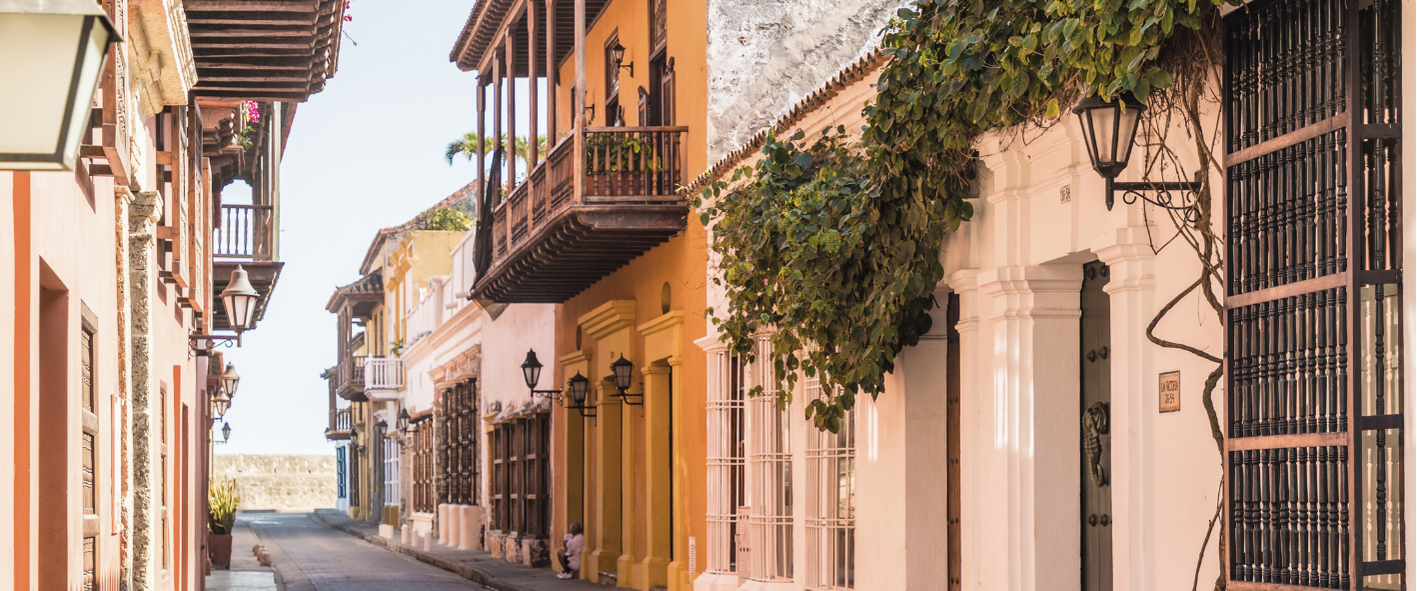
Cartagena's walled city at golden hour with an architect who grew up here. A coffee finca in the Zona Cafetera where the family has been selecting varietals for eighty years. The Pacific coast in whale season, where humpbacks breach 200 metres from shore.
Design your Colombia journey →Colombia's transformation over the past two decades is one of the most significant in the Americas, and the country that travellers encounter today — confident, creative, and in the middle of a genuine cultural renaissance — has little in common with the Colombia of newspaper archives. Bogotá has one of the finest gold collections in the world and a food scene that has attracted international attention without losing its regional specificity. Cartagena's colonial centre, a UNESCO World Heritage Site, is best understood through its architectural layers rather than its postcard angles. The coffee region rewards the visitor who slows to the pace of the finca: understanding that Colombian coffee's complexity comes not from a single estate but from the micro-climates of individual hillsides, the altitude bands, and the decision about when to pick. The Pacific coast, little visited but startlingly beautiful, offers the spectacle of humpback whales calving in the warm waters between Buenaventura and Tumaco every July through October.
Our guide in Cartagena is an architect who was born in Getsemaní, the neighbourhood that adjoins the walled city, and who has spent twenty years documenting the colonial-period construction techniques used in the city's fortifications. He meets you at the Puerta del Reloj at 4:30 p.m. — the hour when the light turns the ochre walls amber — and walks the ramparts and the interior streets pointing out the structural logic of the city's defences, the social geography of which families occupied which blocks, and the current process of restoration and its controversies. The walk ends with a rum on the roof terrace of a restaurant in the Barrio Santo Domingo as the sky goes dark.
The finca family we work with near Salento has been growing coffee at 1,650 metres for three generations and has in the past decade shifted toward specialty production — selecting single-variety Caturra and Tabi lots for export to specialty roasters in Copenhagen and Tokyo. A morning walk through the harvest with the fourth-generation owner, who explains the hand-sorting process and the decision of when a cherry is ready, ends in the farm's processing station where you follow the bean from pulping to fermentation to drying. Lunch is cooked by the owner's grandmother, who is eighty-one and still oversees the kitchen.
Between July and October, humpback whales from Antarctic feeding grounds calve in the warm waters off Colombia's Pacific coast, concentrating around the Utría National Park near Nuquí in numbers unusual for the Americas. We fly you into Nuquí on a twelve-seat light aircraft and base you at a small eco-lodge accessible only by boat, with daily excursions on a private panga to the whale grounds. The same waters host whale sharks and silky sharks; evenings bring the extraordinary spectacle of bioluminescent plankton in the bay around the lodge's dock.
Bogotá to the coffee region, north to Cartagena and Tayrona, with an optional Pacific coast extension. Best December through March or June through August for dry conditions; July–October for Pacific whale season.
Arrive Bogotá and base in the Usaquén neighbourhood. Private evening access to the Museo del Oro to view the Muisca gold collections without crowds — the raft ceremony piece and the votive offerings take on a different weight in silence. Day two: La Candelaria with a local art historian and lunch at Leo, where chef Leonor Espinosa's menu is built around Amazonian and Afro-Colombian ingredients.
Fly to Pereira and transfer to Salento. Two nights at a coffee finca in the hills above town. Morning harvest walk and processing tour on day one; Valle de Cocora wax palms hike with a local naturalist on day two, followed by cupping session with the finca owner in the afternoon.
Fly to Cartagena. First evening: golden-hour walk with the architect guide. Day two: private snorkelling excursion to the Islas del Rosario coral gardens on a chartered boat — the archipelago thirty minutes offshore where the water is 30-degree Caribbean clear. Day three: Getsemaní neighbourhood on foot, exploring the street art and the transformation of the barrio over the past decade.
Transfer to the eastern edge of Tayrona National Park, where the Sierra Nevada de Santa Marta mountains descend directly to the Caribbean. Two nights at a lodge at the park boundary. The trail through the jungle to Cabo San Juan del Guía takes ninety minutes; you arrive at a bay where the palms frame a white sand arc and the water is the colour of aquamarine. Guided night walk for poison dart frogs and kinkajous.
Light aircraft from Medellín or Bogotá to Nuquí on the Pacific coast. Three nights at a lodge accessible only by boat, with daily whale watching excursions into the Utría National Park calving grounds. Evening: bioluminescent plankton in the bay. If not July–October, substitute with Medellín — the city's urban transformation and the Comunas cable car tour with a local urbanist.
A country in the middle of becoming something new — and generous enough to let you witness it at close quarters.
Begin your journey