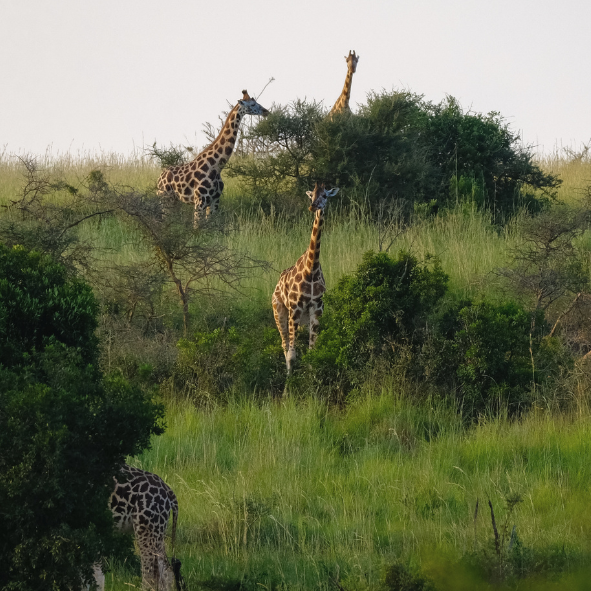
Churchill called Uganda the Pearl of Africa, and the description holds. Within a country roughly the size of the United Kingdom, you can sit with mountain gorillas in ancient forest, spend a full day habituating with a chimpanzee community, watch the Nile leave Lake Victoria at Jinja, and find lions sleeping in fig trees.
Design your Uganda journey →Uganda is compact enough to move between profoundly different ecosystems within a single day's drive, yet each one — the ancient montane forest of Bwindi, the chimpanzee rainforest of Kibale, the savannah and crater lakes of Queen Elizabeth — feels complete and self-contained. Bwindi Impenetrable National Park, named with literal accuracy for the density of its vegetation, protects roughly half the world's mountain gorilla population. The gorilla trekking experience in Bwindi is often described by those who have also trekked in Rwanda as the more raw, more forested, and ultimately more moving of the two. Kibale National Park's chimpanzee habituation experience — a full day with a research community, rather than the one-hour visit of standard trekking — is the deepest primate encounter available anywhere. Queen Elizabeth National Park's Ishasha sector holds the continent's only habitual tree-climbing lions, settling in fig trees for reasons that researchers still debate. Uganda, perhaps because it remains less visited than Kenya and Tanzania, retains a sense of discovery that rewards those who make the effort to come.
Bwindi's four sectors — Buhoma, Ruhija, Rushegura, and Nkuringo — each hold different habituated gorilla families at different altitudes and with different levels of accessibility. The Nkuringo sector in the south sits at 2,400 metres, the highest in the park, and its families are among the least visited — the trek is demanding (thick vegetation, steep terrain) but the isolation during the hour with the gorillas is absolute. We secure permits for these less-trafficked sectors and pair them with the small lodges perched above the forest canopy that have views across the Albertine Rift Valley into the Democratic Republic of Congo.
Standard chimpanzee trekking gives you one hour with a habituated community. The Kibale habituation experience offers the full day — departing at dawn and following a community being habituated to tourism for its first year. You watch them wake, descend from night nests, travel between fruiting trees, groom, display, hunt — the full behavioural range that a one-hour visit can only sample. The Makerere University Biological Field Station has conducted continuous research on Kibale's chimpanzees since 1987; the data accumulated here represents one of the world's most detailed long-term primate studies. A maximum of four participants ensures the encounter stays quiet and the researchers can continue their work undisrupted.
The Ishasha sector of Queen Elizabeth National Park, in Uganda's southwest, is home to lions that have developed the unusual habit of climbing into the wide-spreading branches of wild fig trees and spending the day sleeping ten metres above the ground. The behaviour is also documented in Tanzania's Lake Manyara, and the theories for it range from insect avoidance to improved views for spotting prey — none entirely convincing, which makes the sight more rather than less compelling. A drive through the Ishasha sector at dawn, when the lions are climbing down for the morning hunt, is combined with a boat trip on the Kazinga Channel where hippos, Nile crocodiles, and enormous buffalo herds line the banks at eye level.
This route moves from Entebbe through Kibale Forest, Queen Elizabeth National Park, and down to Bwindi. Best travelled June to September and December to February, when the drier seasons make forest trekking more manageable and savannah wildlife more concentrated at water sources.
Entebbe sits on Lake Victoria's northern shore and has a gentler pace than Kampala. The Ngamba Island Chimpanzee Sanctuary, a thirty-minute boat ride from the pier, holds rescued chimps in a large forest enclosure and offers a morning session at the feeding platform before the afternoon flight or drive west. The Uganda Wildlife Education Centre adjacent to the airport is worth an hour with children.
The drive west from Entebbe to Fort Portal takes four hours through banana plantations and tea estates; Kibale Forest is thirty minutes south of Fort Portal. Two days here allow the full chimpanzee habituation experience on day two and a guided forest walk on day three focused on Kibale's 350-plus bird species, the red-tailed and L'Hoest's monkeys visible from the forest paths, and the cathedral-scale mahogany trees that survived the logging era intact.
Drive south through the tea estates and crater lake district of Kasese to Queen Elizabeth National Park. The afternoon Kazinga Channel boat trip (late afternoon light, hippos at close range) and a dawn game drive on the northern Kasenyi plains for elephant herds and lion prides. Day five drives to the Ishasha sector — the southern section of the park — for tree-climbing lion searching and a night at a small lodge above the Ntungwe River.
Three nights in Bwindi: gorilla trekking on day six, a recovery day with a guided walk in the community forest zone on day seven (birding, medicinal plants, encounters with the local Batwa guide community), and a second gorilla permit on day eight if available — many travellers choose to trek twice in Bwindi. The Batwa Cultural Experience, led by Batwa guides who were forest-dwelling hunter-gatherers before the park's creation, provides an important contextual layer to the forest visit.
A drive or flight back east to Jinja, where the Nile leaves Lake Victoria and begins its 6,650-kilometre journey to the Mediterranean. A morning kayak on the upper Nile — through the Owen Falls and past the Bujagali rapids — is followed by a visit to the source site where Speke first recorded the Nile's origin in 1862. A final dinner in Jinja's growing restaurant scene before the short drive back to Entebbe for departure.
Uganda's gorilla and chimpanzee permits require advance booking and sector selection — we secure the best access and build the rest of the journey around it.
Begin your journey