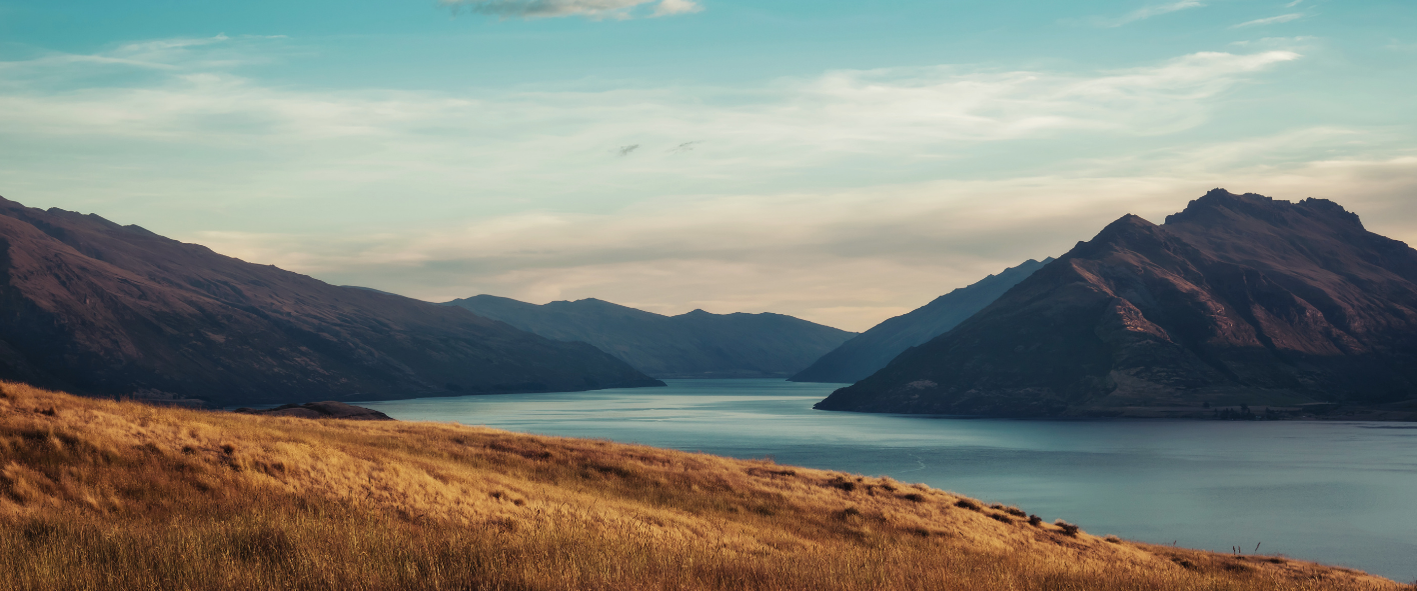
New Zealand's most extraordinary places have no road access. The fiords that no tourist ferry reaches, the alpine lakes visible only from a helicopter, the glacial valleys where the walking tracks end and the wilderness begins in earnest — these are the New Zealand we design journeys into.
Design your New Zealand journey →New Zealand finished forming geologically about five million years ago, and in geological terms that makes it very young — which explains why it still looks so raw. The Fiordland coast is the most dramatic on earth: sheer cliffs dropping a thousand metres straight into black water, permanent waterfalls running from cliff faces that receive seven metres of rain per year, and a silence in the valleys that is only broken by the kea — the alpine parrot that figures out, within thirty seconds, how to open your pack. The Milford Track, walked over four days through Fiordland to Milford Sound, is more beautiful than any photograph has ever suggested, and the lodges we book on it are a very different experience from the Department of Conservation huts used by independent walkers. Māori culture is not a performance at a cultural centre — it is a living tradition maintained by families, and the immersion we arrange is with a Ngāti Porou family in the East Cape region who treat guests as guests, sharing kai (food), whakapapa (genealogy), and the stories encoded in the carved meeting house behind their property. New Zealand rewards those who resist the temptation to see everything and choose instead to be somewhere properly.
Fiordland National Park covers 1.2 million hectares of the most remote terrain in the Southern Hemisphere, and Milford Sound — the famous one — is the only fiord with road access. We charter a private helicopter from Queenstown or Te Anau and fly into one of the fourteen other fiords: Dusky Sound (where Cook anchored in 1773 and saw no sign of human habitation), Preservation Inlet, or the Harrison-Whanganui system — landing on a private beach where the helicopter turns off its engine and the silence of Fiordland fills the space around you, broken only by waterfalls and the occasional kea working on the rotor blades.
The East Cape region on the North Island's northeastern tip is the most Māori-speaking area in New Zealand, and the family we work with there — Ngāti Porou descendants, six generations on the same land — have chosen to welcome a very small number of guests per year into their home. The visit is not a cultural show: it involves a day of working alongside the family on their smallholding, a shared hangi dinner cooked over hot stones in the ground, and an evening in the carved meeting house where the whakapapa of the carvings is explained by a grandmother who has been telling these stories since her own childhood.
The Milford Track is 53.5 kilometres of alpine valley, glacier-carved gorge, and ancient beech forest, walked over four days between Lake Te Anau and Milford Sound. The independent walking version involves booking a year in advance and sharing Department of Conservation huts with forty strangers. The guided version we arrange uses the same track but stays in private lodge accommodation with hot showers, three-course dinners, and guides who have walked every section hundreds of times and know which rock outcrop holds the best Fiordland robin feeding spots. The Sutherland Falls — the fifth highest in the world, reached on day three — arrive without warning around a bend in the valley.
This itinerary covers both islands, moving from Auckland through Rotorua and the East Cape to Hawke's Bay, then crossing to the South Island for Queenstown, Fiordland, and the Milford Track. October to April brings the best walking conditions and the most reliable weather in the south.
Arrive into Auckland and drive south to the Waitomo Caves — the glow-worm grotto is best experienced on a private boat charter before the group tours arrive at nine. Continue to Rotorua for two nights at a geothermal lodge where the pools are fed from the same volcanic system that keeps the Wai-O-Tapu thermal park running. Private dawn walk through the Wai-O-Tapu fields with a geologist guide before the coloured lakes are lit by tourist spotlights.
Drive to the East Cape. One full day and night with the Ngāti Porou family — the hangi preparation, the shared dinner, the evening in the meeting house with the grandmother who knows the whakapapa of every carved figure on the walls. The following morning, drive along the East Cape lighthouse road, which runs along the coast that sees the first sunrise in the world each day, and eat breakfast watching the sun come up over the Pacific.
Drive south to Hawke's Bay, New Zealand's warmest wine region. Private estate visit with the winemaker at a small Gimblett Gravels producer — a morning in the vineyard during harvest (February–April), followed by a barrel tasting in the cellar and lunch on the terrace. Afternoon at Cape Kidnappers gannet colony, where 20,000 Australasian gannets nest on a cliff headland accessible only on foot at low tide.
Fly to Queenstown. Private helicopter into Fiordland on day nine — Dusky Sound or Preservation Inlet, landing on a remote beach for two hours of absolute silence before flying back via the Hollyford Valley. Day ten: Lake Wanaka, the Rob Roy Glacier Valley walk, and an evening at a private vineyard above the lake where the Central Otago pinot noir is as good as anything produced in the Southern Hemisphere.
Transfer to Te Anau and board the private boat across Lake Te Anau to the Milford Track trailhead. Four days walking to Milford Sound — the Clinton River beech forest on day one, the MacKinnon Pass crossing on day three (1,154 metres, snow possible in all months), the Sutherland Falls on the descent, and Milford Sound itself at the finish. Private launch cruise on the final morning before the flight back to Queenstown.
Whether you want to walk the Milford Track in lodge luxury, fly into a fiord that has no name, or spend an evening learning whakapapa from a grandmother on the East Cape — we design the New Zealand that no travel agent has ever put in a brochure.
Begin your journey