Montenegro is the Adriatic before the infrastructure caught up — a country where the deepest canyon in Europe is three hours from the most dramatically beautiful bay, and where the highland winegrowers have been making Vranac since before the idea of wine tourism existed.
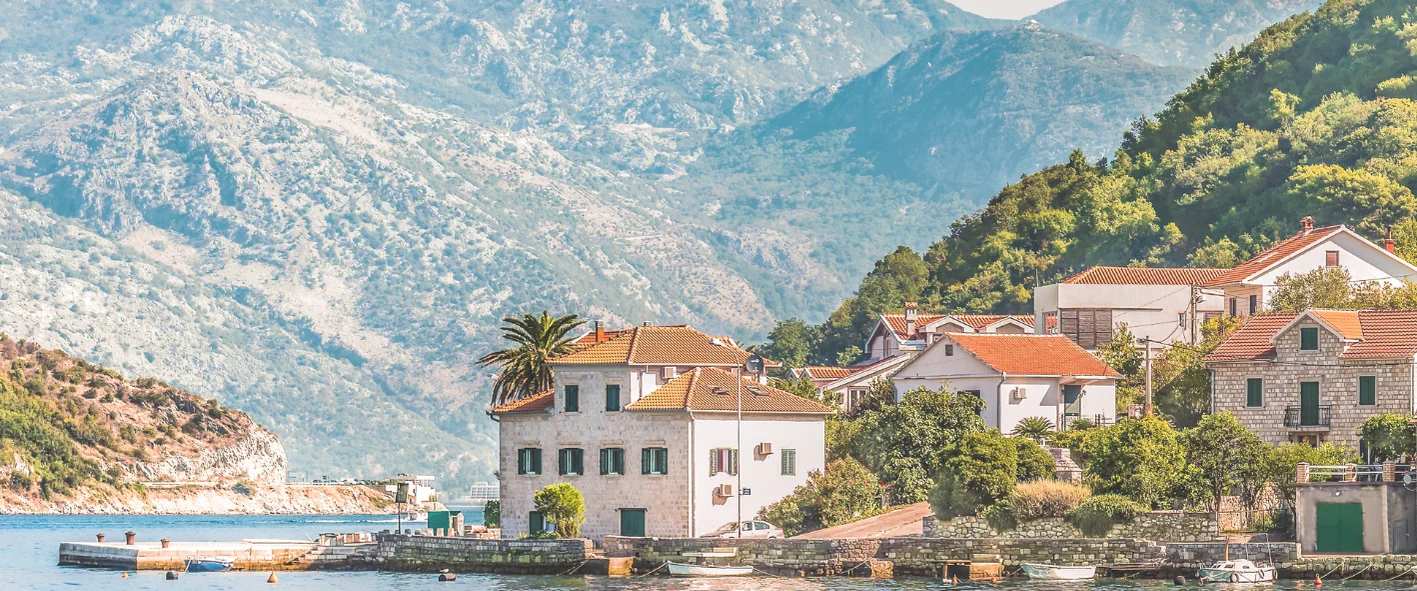
Design your Montenegro journey →Montenegro is a country that fits entirely within the area of Wales, yet manages to contain within it an extraordinary range of terrain: the Adriatic coast with its fjord-like Bay of Kotor, the Lovćen massif that rises directly from the water to 1,700 metres, the Tara River canyon which descends to 1,300 metres — the deepest in Europe — and the Prokletije range in the east where shepherds still practice transhumance. The bay of Kotor, which the Romans called Acruvium and the Venetians called Cattaro, is unlike any other body of water in the Adriatic: entirely enclosed, fifty kilometres of coastline, surrounded on all sides by limestone mountains that catch the afternoon light in a way that seems implausible. Seen from the deck of a private sailing boat at dawn, before any other vessel has moved, it is one of the most affecting views in the Mediterranean. The interior — Njeguši village, the Montenegrin highlands, the oak-forest valleys where the local Vranac grape produces dark, serious wine — is a different country entirely from the coast, and requires different pacing.
The Bay of Kotor is 50 kilometres of enclosed water, ringed by limestone mountains — not a bay in any conventional sense but four interconnected fjords of Adriatic sea. We charter a private vessel (crewed, 14-16 metres) for a two-day circuit of the bay, anchoring overnight at Perast opposite the island church of Our Lady of the Rocks, and departing at 6am before any charter traffic arrives. The skipper's family has fished and sailed Boka Kotorska for four generations, and understands the bay's winds, currents and anchorages as intimately as any place can be known.
The Tara River canyon in the Durmitor National Park is 82 kilometres long and reaches 1,300 metres in depth — making it the second deepest canyon in the world after the Colorado, and the deepest in Europe. The water is glacially cold and startlingly clear, fed by snowmelt from the Durmitor massif. We arrange a private two-day rafting descent with a guide who has been running the canyon for twenty years: Grade III rapids through the lower section, overnight in a wooden camp on the riverbank, the walls of the canyon rising on both sides in a silence broken only by the river.
Vranac — Montenegro's indigenous red grape, the name means "black horse" — produces deep, tannic wine at altitude in the Montenegrin highlands and the Crmnica wine region above Lake Skadar. We arrange a private visit to a small family vineyard that does not export and does not conduct commercial tastings: the winemaker opens his cellar for guests who arrive by arrangement only, pours from barrels rather than bottles, and serves the wine with smoked lamb and local cheese in the shade of a stone barn that his grandfather built. This is the Montenegro that the coast road doesn't reach.
A journey that combines the Kotor Bay coast with the Durmitor highlands and Lovćen National Park. Best in May or September, when the coastal heat has not yet arrived or has already passed, and the mountains are accessible without summer crowds.
Arrival in Tivat or Dubrovnik with transfer to Kotor. Private evening walk of the medieval Old City walls with a local historian — Kotor is a UNESCO site, a former Venetian outpost, and its street plan has not materially changed since the 14th century. Two-day sailing circuit of the bay beginning at dawn on day two: Perast, Our Lady of the Rocks, the narrows at Kamenari, anchorage at Risan near the Roman mosaic floor.
Drive up to Lovćen, the mountain that gives Montenegro its name (Crna Gora — black mountain). Private dawn visit to the Njegoš Mausoleum — the tomb of the 19th-century poet-prince Petar II Petrović-Njegoš, cut into the rock at 1,657 metres, designed by Ivan Meštrović. The view from here, stretching across the Bay of Kotor on one side and the Montenegrin interior on the other, is the country's defining panorama.
Transfer north to the Durmitor plateau. Two-day private rafting descent of the Tara canyon with overnight camp on the riverbank. The canyon walls reach 1,300 metres on both sides; the water temperature is 8 degrees in June. A guide who has rafted this stretch 400 times narrates the geology, the flora and the history of the canyon's former timber trade as you move through it.
Transfer to the Crmnica region above Lake Skadar. Private vineyard visit and cellar tasting with a Vranac producer — barrel samples, smoked lamb, the view across the lake to Albania. An afternoon walk through the Rijeka Crnojevića river valley, which connects the Lovćen massif to the lake and contains some of the oldest cultivated terraces in the Balkans.
Final day on the Budva Riviera. The medieval Stari Grad of Budva, seen at 6pm when the afternoon light hits the Venetian walls from the west and the Adriatic is the colour of hammered copper, is the most cinematically beautiful moment on the Montenegrin coast. Dinner at a konoba in the old town where the owner's grandmother still makes the pršut and the olive oil comes from trees planted by her grandfather. Departure from Tivat or Dubrovnik.
Montenegro is Europe's last secret — a country that hasn't yet learned to simplify itself for visitors, which is precisely what makes it irreplaceable.
Begin your journey