inspiring travel
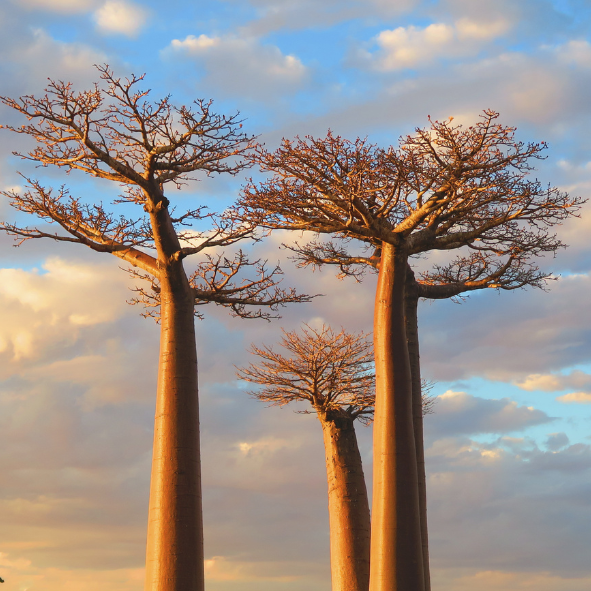
The Avenue of the Baobabs near Morondava, ancient trees silhouetted against a coral sunset sky
Indian Ocean · Madagascar

The island that evolved
entirely alone

Madagascar split from the African continent 165 million years ago and spent the time since inventing its own world. Ninety percent of its wildlife exists nowhere else: 107 species of lemur, chameleons that turn colour in real-time, baobabs as old as cathedrals, and rainforests that have never been replicated.

Design your Madagascar journey →
Scroll

When Madagascar broke away from Africa, it took with it a selection of species that would then evolve in isolation for longer than mammals have existed in their current form. The result is an island with no lions, no elephants, and no large predators — but with a biological inventory so unusual that every walk in its forests is a taxonomist's private discovery. Ranomafana National Park in the highlands is where golden bamboo lemurs were first documented in 1986, a species so recently known to science that its habitat was catalogued before its name. The Avenue of the Baobabs near Morondava is a survivor of a vanished forest — twenty or so Grandidier's baobabs lining a red laterite road, some of them 800 years old, all of them photographed at dusk when the sky goes coral and the silhouettes are improbable. The north offers turquoise water and white sand on Nosy Be, where small private island camps can be arranged. Madagascar is logistically challenging and richly worth it.

Signature experiences

How we design
your Madagascar

Indri lemur calling from a rainforest canopy in Andasibe National Park at dawn
Wildlife

Lemur tracking in Ranomafana

Ranomafana was gazetted as a national park specifically to protect the golden bamboo lemur after its discovery; the park's research station has produced continuous wildlife data for nearly four decades, which means the guides here understand individual animals by sight. Dawn walks into the rainforest with a researcher-trained naturalist bring you to family groups of greater bamboo lemurs feeding in the canopy, red-fronted brown lemurs at eye level, and — with patience — the nocturnal aye-aye emerging from its tree-hole roost at dusk. The forest's understory is also home to 115 species of frog, most found nowhere else.

Ancient Grandidier's baobabs silhouetted against a vivid orange and pink sunset near Morondava
Slow Travel

The Avenue of the Baobabs at dusk and dawn

Most visitors arrive at the Avenue of the Baobabs for the sunset shot and leave within forty minutes. We design stays at small lodges within easy reach so you can be there at dawn too — when the road is empty, a mist sometimes sits in the fields between the trees, and the light is cooler and stranger than the celebrated dusk version. A guide from a local Sakalava family explains the cultural significance of the baobab in Malagasy tradition: these trees are not monuments, they are neighbours. The nearby Kirindy dry forest is a half-day addition where fosa — Madagascar's largest predator, a cat-like carnivore related to the mongoose — can be found.

Private overwater bungalow with turquoise lagoon and palm-edged beach on Nosy Be island
Slow Travel

Private beach camp on Nosy Iranja

Nosy Iranja is a small island south of Nosy Be connected to a satellite islet by a sandbar that submerges at high tide — a landscape that changes its shape twice daily. From July to September, hawksbill and green sea turtles nest on the southern beach. We arrange private camp setups on the island — simple canvas and hardwood structures with a resident cook, fresh catches from the local fishing pirogues, and snorkelling over coral gardens where nudibranchs catalogue themselves in colour combinations the island's vegetation seems to have inspired. No permanent hotel exists here; your arrangement depends on advance planning.

A suggested journey

11 days
across an island that rewired evolution

This route moves from the highland rainforests south to the western baobab country, then north to the islands of Nosy Be. Best travelled April to November, avoiding the December to March cyclone season on the east coast; the west and north are accessible year-round but driest from May to October.

Day 1–2

Antananarivo — Rova Palace, Zoma Market, Lemur's Park

Antananarivo sits on twelve hills and has a character shaped by Merina Highland culture, French colonial architecture, and a street life that starts at 5am. The Rova palace complex commands the highest hill; Lemur's Park on the city's western outskirts provides an acclimatisation encounter with several rescued species before the wild encounters in the interior.

Day 3–4

Ranomafana National Park — lemur research forest

A three-hour drive southeast to Ranomafana delivers you into moist montane rainforest where the guides have been tracking the same lemur families for years. Two full days allow dawn walks for diurnal species, an afternoon devoted to reptiles and frogs, and a night walk with headtorches for the mouse lemurs that move along the branches at eye level in the dark. The Ranomafana village has a family of indri nearby that calls at dawn — the loudest call of any living primate.

Day 5–6

Morondava — Avenue of the Baobabs, Kirindy Forest

An internal flight to Morondava, arriving in time for the afternoon at the Avenue. The following dawn returns before any other visitor arrives. The half-day in Kirindy dry deciduous forest adds fosa, giant jumping rats, and — in the dry season — large groups of Verreaux's sifaka making their lateral sideways leaps across the sandy forest floor.

Day 7–8

Nosy Be — Lokobe reserve, spice tour

Flight north to Nosy Be, Madagascar's main island resort. The Lokobe nature reserve in the island's southeast corner holds the last intact fragment of lowland rainforest on Nosy Be, with black lemurs and Nosy Be's famous panther chameleons accessible on guided walks. The island's vanilla, ylang-ylang, and pepper plantations are a secondary exploration — the scent of ylang-ylang drying in the afternoon heat is one of Madagascar's distinctive olfactory memories.

Day 9–11

Nosy Iranja — private island camp, turtles, coral

The boat transfer to Nosy Iranja takes forty minutes from Nosy Be's harbour. Three days on the island follow the tides: snorkelling at high water over the reef's outer edge, walking the sandbar at low tide, and watching the sky over the Indian Ocean change through its full evening sequence from copper to indigo. Return to Nosy Be for the flight home via Antananarivo.

Your Madagascar story
begins here.

Madagascar requires careful logistics and insider knowledge — we've done the groundwork so that what you experience is the island's wonder, not its difficulty.

Begin your journey