Ireland's west coast is one of the oldest inhabited landscapes in Europe and one of the least tamed. A private fishing charter out of Castletownshend. Skellig Michael, 180 daily visitors, your permit secured months in advance. The Aran Islands explained in Gaelic by someone who grew up speaking it at home.
Design your Ireland journey →Ireland is a small country that contains an improbable density of things worth understanding: an ancient literary culture, a landscape that looks as though it was designed by someone who couldn't decide between mountains and sea, and a tradition of hospitality that has nothing to do with the hospitality industry. The west — Connemara, Clare, Kerry — remains genuinely remote in the way that most of Europe is not: the road from Clifden to the Killary Fjord crosses bog that has not changed in 4,000 years, and the light on it in May, when the days are seventeen hours long and the Irish sky is doing five different things at once, is impossible to prepare for and impossible to forget. Skellig Michael — the 6th-century monastic settlement on a rock eight miles off the Kerry coast — admits exactly 180 visitors per day between May and October, and the permits go fast. We secure them as part of the journey's architecture, not as an afterthought.
The waters off West Cork — the Mizen Head peninsula, the Fastnet Rock, the maze of islands between Schull and Bantry — contain wild Atlantic salmon, mackerel, sea bass and pollock in quantities that are difficult to find elsewhere along the Irish coast. We charter a private vessel out of Castletownshend with a skipper who has fished these waters for thirty years and knows the tides, the currents and the specific locations that the charter boat circuit doesn't reach. The catch comes back to the kitchen of your accommodation that evening.
Skellig Michael is an extraordinary thing: a pyramid of rock rising 218 metres from the Atlantic, on which 6th-century monks built a monastery of six beehive cells, two oratories and three terraced gardens, connected by 600 steps cut directly into the stone. The Office of Public Works limits access to 180 visitors per day, weather permitting, between May and October. We book the permits far in advance and pair the landing with a briefing from a maritime archaeologist who has worked on the Skellig's documentation project — so the ascent is a conversation, not just a climb.
We work with one privately-held lough estate in Connemara — not a hotel, a family property that accepts a small number of guests by arrangement — where a ghillie who has been reading this particular water for twenty-five years guides the salmon and sea-trout fishing. The ghillie's knowledge is geological as much as it is piscatorial: he knows the lough's structure, the inlet streams, the specific boulders where the fish hold, and the Connemara weather well enough to know when not to fish. Evenings are spent in a house that has belonged to the same family since the 1860s.
A journey that begins in Dublin with a private literary evening and moves west through Clare and Connemara to Kerry and the Aran Islands. Best in May or June when the days are longest and the west-coast weather is at its most negotiable.
Arrival and two nights in Dublin. Private evening in the Long Room of Trinity College Library — arranged through the College's Office of the Provost for a small group after closing — seeing the Book of Kells illuminated manuscripts and the 200,000 pre-1800 volumes in their original oak shelving. A literary evening follows: readings from Beckett, Heaney and Boland at a Georgian townhouse in Merrion Square with a professor of Irish literature who makes both the texts and the context unavoidable.
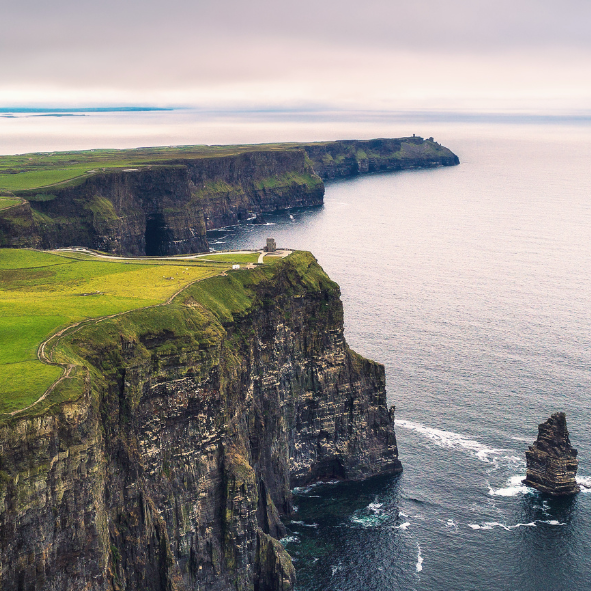
Drive west to County Clare. The Burren — 250 square kilometres of carboniferous limestone pavement that supports Arctic, Mediterranean and Alpine plants simultaneously — with a botanist guide who has been studying its flora for fifteen years. Overnight near the Cliffs of Moher, seen at dawn before the visitor centre opens: just the cliff edge, the Atlantic 200 metres below, and the sound of the fulmars.
Transfer north to Connemara. Two nights at the private lough estate with ghillie fishing for salmon and sea-trout. An afternoon walk to the Twelve Bens with a local mountain guide. A visit to a Connemara wool weaver in Clifden who supplies a small number of London tailors and has no shop.
Private boat from Rossaveel to Inis Mór — the largest of the three Aran Islands. Two days with a Gaelic-speaking scholar from the National University of Ireland who grew up on the island and returns regularly to document its oral traditions. Dún Aonghasa, the prehistoric ring fort on a 100-metre cliff above the Atlantic, seen with an archaeologist's commentary that makes the Iron Age logic of its position entirely clear.
Transfer south to Kerry. Private fishing charter out of Portmagee on day nine — mackerel and pollock in the Skellig waters. Day ten: landing on Skellig Michael with a pre-secured OPW permit and a maritime archaeologist guide. The 600 steps, the beehive cells, the view back to the Kerry coast from 218 metres above the Atlantic. Return to land for a farewell dinner at a West Kerry restaurant that serves nothing that didn't come from within ten kilometres.
Ireland gives its best things to those who come with patience, curiosity and a willingness to be soaked to the skin by a west-coast squall — and consider it part of the experience.
Begin your journey