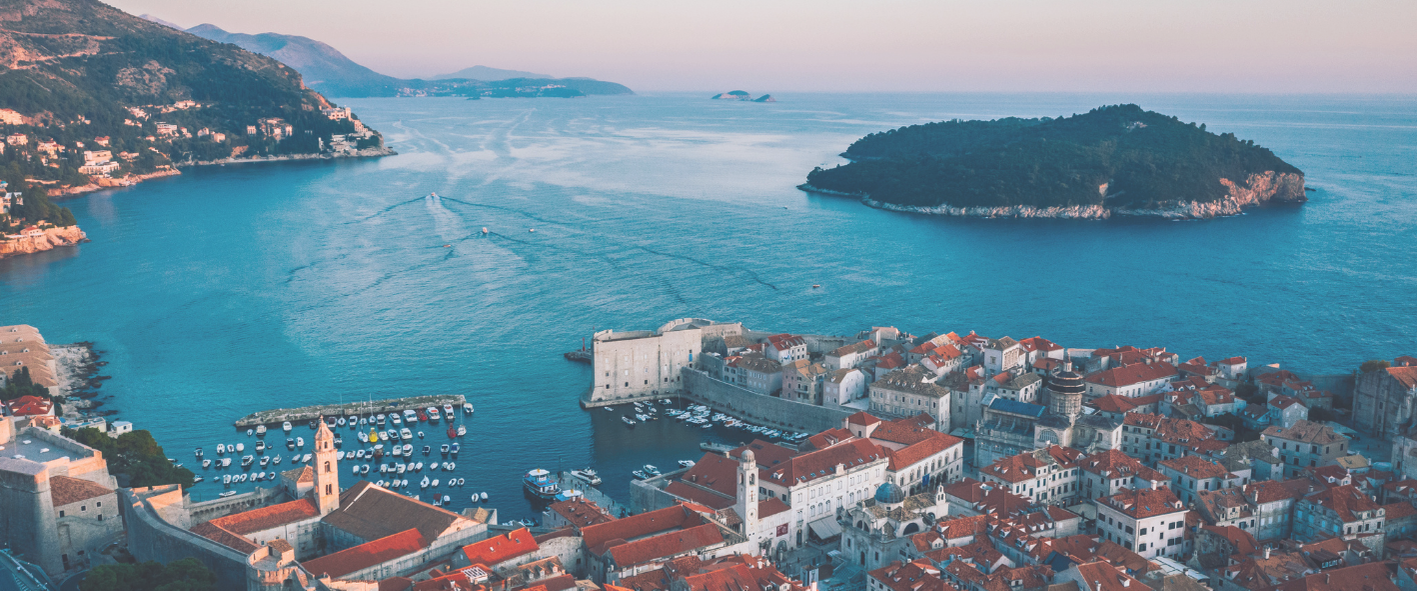
Croatia's coast is one of the most beautiful in the world — and one of the most mishandled. We sail past the marinas, past the charter fleets, and drop anchor in bays that have no name on the tourist maps. The Adriatic, as it was before the season arrived.
Design your Croatia journey →The Dalmatian coast has been loved nearly to death, and yet it remains possible to find the version of Croatia that existed before the charter boats arrived — you simply need to know which coves are accessible only by sea, and which hours belong only to the fishermen. Dubrovnik's Old City, seen at 6am on a June morning when the light is low and the Stradun belongs to two cats and a baker, is one of the genuinely beautiful things in the world. The island of Vis, closed to foreign visitors for the entire duration of Yugoslav military occupation and only reopened in 1991, retains a rawness that its more polished neighbours lost a generation ago. And Hvar in lavender season — late June, before the yachts arrive — is something else entirely: purple hillsides, the scent of cut stems, and producers who still distil by hand in stone buildings their grandfathers built.
We charter a crewed gulet — 18 to 22 metres, three cabins, a crew of two — and design a route through the islands that specifically avoids the ACI marina network. Anchorages are chosen for their isolation: the western bays of Lastovo, the uninhabited island of Sušac, the north coast of Vis where there is no road. The captain has sailed this coast for twenty years and knows which cave is swimmable at high water and which beach catches the morning sun.
We arrange arrival and accommodation within the city walls — there are fewer than a dozen properties inside the Stari Grad, and booking them requires patience and existing relationships. The walk along the city walls begins at 7:30am, before the cruise ship passengers disembark, with a local historian who has been studying Ragusan Republic archives for a decade. By the time the crowds arrive, you are already at a table in a konoba that doesn't appear on any list, eating grilled fish that came off the boat an hour earlier.
For four decades, Vis was a Yugoslav military base closed to all foreign visitors. The infrastructure that other Dalmatian islands acquired during the tourism boom of the 1980s and 1990s simply never arrived here. What remains is an island that looks and feels like Dalmatia did a generation ago: dry-stone walls, wild capers, a wine tradition that predates the Roman occupation, and fishermen who have no particular interest in converting their boats to tourist excursions. We arrange a stay with a family who restored a 16th-century kula on the hillside above Komiža.
A journey that begins in Dubrovnik, transfers to a private sailing route through the southern Dalmatian islands, and ends on Vis. Best travelled in late May or early September, when the light is long and the charter fleets have not yet arrived in force.
Arrival and two nights inside the city walls. Early morning walk with a Ragusan history scholar. Private kayak along the base of the sea walls at dusk. Dinner at a restaurant that serves only what the owner's family grows or catches.
Transfer south to Mljet, Croatia's most forested island — a national park where two saltwater lakes connect to the sea. Afternoon sailing to Korčula town, birthplace of Marco Polo, for a private evening with a local restorer who has spent years documenting the island's medieval architecture.
Arrive in Hvar harbour before 8am. Lavender fields in the Stari Grad plain (a UNESCO site, one of the oldest surviving Greek land divisions in the world). Private visit to a family distillery above Velo Grablje village, where Hvar's traditional lavender oil production is still practised by two families.
Sail to Vis — anchor in Stončica bay, away from the town. Morning excursion to the Blue Cave on the island of Biševo (privately arranged, before the excursion boats arrive at 10am). Afternoon: wine tasting at a Vugava producer whose vineyard predates any current map. Evening in Komiža with the harbour fishermen.
Transfer north for a single night near Plitvice Lakes National Park. Private entry at 6:30am — the park opens at 7am for regular visitors, but an arrangement with the park authority allows earlier access. The sixteen interconnected lakes and their travertine waterfalls, seen with no one else present, are among the most remarkable things in Central Europe. Departure from Zagreb or Split.
The Croatia worth finding is the one that has no season — only the sea, the stone and the particular quiet of a bay that has no name on any tourist map.
Begin your journey